
Harlem Criminal History Checks
A Harlem report, booking, municipal disposition, and state history answer different questions. Police describes the event and officer action. The municipal court records what happened to a city case. Columbia County documents detention and county court proceedings. GCIC compiles reportable Georgia arrest cycles and outcomes, but reporting time and court level can leave gaps. Define the record first.
This order keeps a request at city altitude while preserving a clear fallback:
- Ask Harlem Police for the known accident, incident, miscellaneous, or arrest report.
- Send a written city request when the report needs research or redaction.
- Contact the Municipal Court Clerk for a citation or ordinance disposition.
- Confirm custody through Columbia County’s jail channels.
- Use official GBI/GCIC review routes for broader Georgia history.
Harlem Police Report Requests
The Harlem Police Department page identifies the Public Safety Building as the city police contact point.
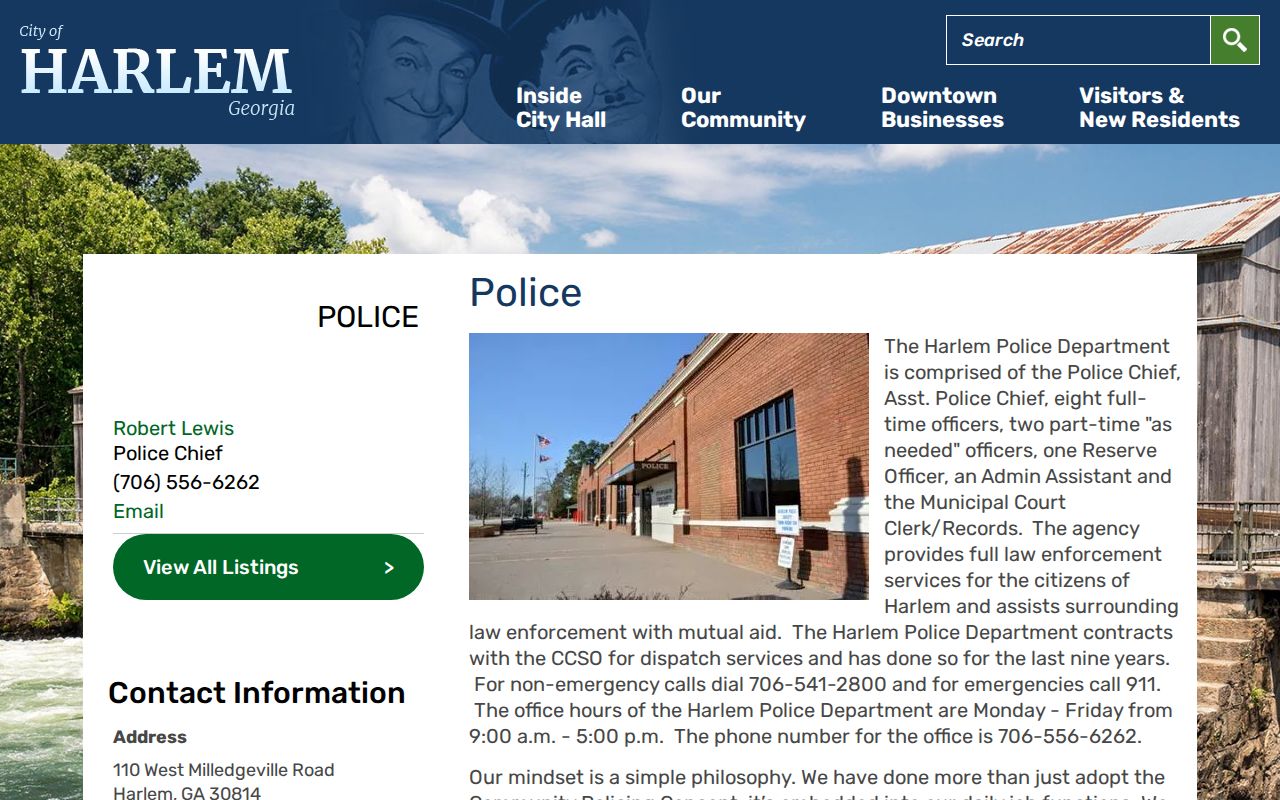
The official page connects Harlem residents with the department that holds routine police reports.
The Public Safety Building is at 110 West Milledgeville Road, Harlem, GA 30814. The office number is 706-556-6262, and pdrecords@harlemga.org reaches police records. Published office hours are Monday through Friday, 9:00 a.m. to 5:00 p.m. Columbia County Sheriff provides nonemergency dispatch at 706-541-2800, while emergencies go to 911. That shared dispatch arrangement does not transfer custody of a Harlem officer’s report to the Sheriff.
Records at the Harlem Police Department
Harlem Police handles routine accident, incident, and miscellaneous reports along with police research and analysis. The Police Chief or a designee serves as records officer. The department includes the chief, assistant chief, eight full-time officers, two part-time officers used as needed, a reserve officer, and administrative and court-record functions. It also takes part in mutual aid.
Those working relationships can place several agency names around one event. Start with the officer or report agency shown on any citation, exchange sheet, or case notice. A call dispatched through Columbia County can still yield a Harlem police report. Conversely, a county deputy’s report stays with the Sheriff. Use the event date, place, involved names, and any report number to help staff locate the right file.
Harlem Email, Counter, and City Routes
Harlem’s August 2025 open-records policy allows a written request to the City Manager or Clerk at City Hall, 320 North Louisville Street, Harlem, GA 30814. The city contact is 706-556-3448 and cityofharlem@harlemga.org, with weekday hours of 8:30 a.m. to 5:00 p.m. Informal verbal requests are allowed. Routine ordinances, resolutions, agendas, maps, and minutes do not require a formal form.
Police records should go to the police channel when practical. Municipal dispositions go to the Municipal Court Clerk. The city supplies a request form on request, but no downloadable field inventory was verified. Do not wait for an online form that may not exist. A plain written request can state the record sought, approximate date, involved name, location, preferred electronic format, and contact details.
The official City of Harlem site is the source for the city’s current office links and notices.
That city channel is useful when a request belongs with the Clerk rather than police.
Booking and Arrest Records in Harlem
Harlem advertises no city jail. Official council records describe the Records and Court Clerk traveling to the Columbia County jail, including on weekends, for 48-hour hearings. An official fingerprint document also names Columbia County Detention Center Jail Administration. Together, those records support routing a Harlem arrest to the county active-inmate catalog and County Camp Road facility.
This is an inference from official operations, not a promise that every person arrested by Harlem Police is booked there. Call Harlem Police or the jail to confirm an individual custody path. The city police report remains with Harlem. Booking status, bond, and release information belong to the detention custodian. Charges later filed in a county court belong to its clerk. For more detail on that custody layer, use the contextual Columbia County arrest search overview.
Harlem Record Fees and Timing
Harlem must produce a public record, cite the legal basis for denial, or give a production timetable within three business days. That period is for the agency response and does not guarantee that a large or heavily redacted file will be ready in three days. Inspection takes place during normal business hours.
Paper copies cost ten cents per page. The first 15 minutes of staff time are free. After that, the city may charge for research, retrieval, redaction, and monitoring at the salary rate of the lowest-paid qualified full-time employee. A requester may ask for electronic data in its native format or a standard export the system supports. A narrow date range and clear report description can reduce search time and cost.
The Harlem Municipal Court File
The official Harlem Municipal Court page identifies the city court channel, though the page itself offers little case-search detail.
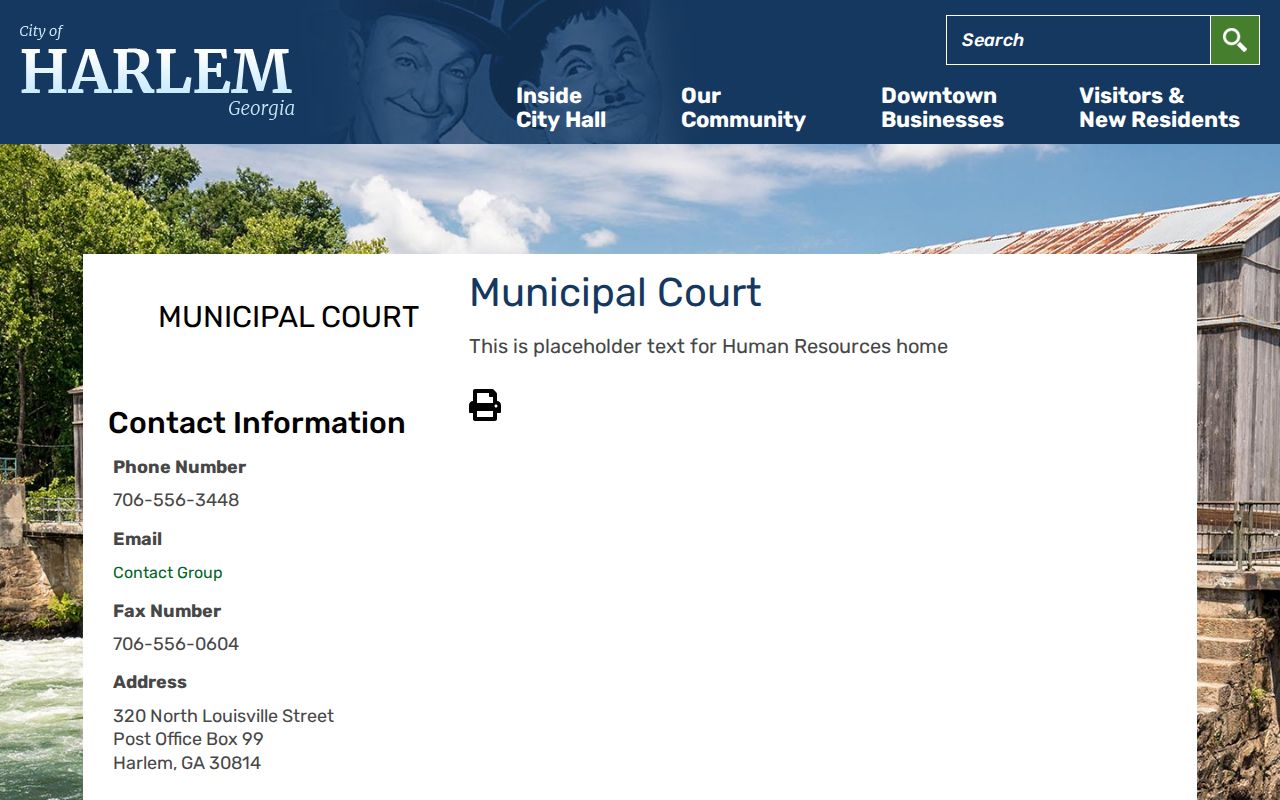
The sparse page makes direct clerk contact the supported way to request a Harlem disposition.
Clerk Deborah James can be reached at 706-556-6262 through the Public Safety Building. No verified public municipal case portal, current online fine instructions, current judge page, or posted copy and search fee was found. A historic court document lists a fax, but its present status should be checked before use.
| Court Name | Harlem Municipal Court |
|---|---|
| Case Types Heard | Charter and city-ordinance violations plus other matters allowed by law |
| Case Lookup Channel | Municipal Court Clerk by telephone or at the Public Safety Building |
| What the File Shows | Citation, docket events, plea, disposition, and sentence when applicable |
| Copies & Fees | Ask the clerk; no current court-specific fee was verified |
Harlem Has No Verified Case Portal
A blank or sparse municipal webpage is not proof that a Harlem case does not exist. The city charter creates chief, associate, and standby judges. It requires judges to be Georgia Bar members and at least 21 years old, and it gives the court jurisdiction over charter and ordinance violations plus other legally assigned matters. The records can exist even without a public name-search screen.
Call the clerk with the citation number, person’s name, and approximate date. Ask for the disposition if the goal is to learn the outcome. A police report will not supply the final plea or sentence, and a county docket may omit a matter that stayed in Harlem Municipal Court. If the clerk says the case moved elsewhere, then follow that specific referral.
How Harlem Records Reach the County
Harlem Police creates the incident or arrest report. A custody event usually points toward Columbia County’s detention system, while the municipal clerk holds city ordinance and assigned violation files. County-level charges create records with the proper Columbia County court. Reportable fingerprints and dispositions can later reach the Georgia Bureau of Investigation’s GCIC repository.
Record flow: Harlem Police › Columbia County Courts › Georgia Bureau of Investigation and GCIC
The path is not instant. A recent Harlem arrest can appear in local custody data before a prosecutor files a case. A final disposition may take more time to reach state history. When two sources disagree, compare identifiers and dates and ask the originating office to correct its own record. Fingerprints, not a name alone, are the sound way to confirm identity in a state history.
Harlem Initial Reports and Redactions
A pending investigation does not make every Harlem police record unavailable. The city policy recognizes initial arrest, accident, and incident reports as exceptions to the pending-investigation withholding rule. That means the initial public portion may be released while later investigative work remains protected.
Juvenile identity, protected personal details, confidential sources, and active investigative material can still be withheld or redacted. Ask for the initial report by name if that is what you need. If the city withholds all or part of it, request the cited legal basis. A redacted report is not the same as a finding that no event occurred, and an initial report does not establish guilt.
Harlem Crime Data Needs an ORI
Harlem publishes no official arrest blotter or city crime dashboard. The agency identifier GA0360200 can help distinguish Harlem Police submissions in official crime-data systems. FBI Crime Data Explorer is one possible route. GBI’s public statistics database was marked unavailable during research, and its landing page listed the UCR unit at 404-270-8399.
Agency submissions are counts under reporting rules, not estimates of crimes that were never reported. Arrest totals are not conviction totals. Do not casually add Harlem, Grovetown, and Sheriff figures because jurisdiction, reporting participation, and duplicate events can distort the result. For a personal case question, the actual report and court disposition are more useful than an annual chart.
Harlem Records in a Railroad City
Harlem began as Saw Dust after the Georgia Railroad arrived in 1835. Dr. Andrew Sanders came in 1857, sold land, donated church and school sites, and became first mayor. Harlem was founded in 1870, and Saw Dust was absorbed in 1887. Later additions included Cerlastae and Berzelia. The last passenger train ran in 1983.
That history helps explain why old Harlem material may live in minutes, ordinances, archives, or paper files rather than a modern police portal. Oliver Hardy’s 1892 birthplace and the city’s annual October festival are civic history, not criminal-history search tools. No resident-facing Harlem criminal-record app was found. For a current police or court record, direct contact remains the reliable route.
Harlem Record Access Rules
The Georgia Open Records Act applies to Harlem’s existing public records, subject to exemptions. It does not require the city to answer legal questions or create a new report that does not exist. Describe the file rather than asking staff to research a person’s whole life. Electronic delivery can limit copy charges, though staff time may still apply when retrieval or redaction is needed.
Key Statutes:
Georgia Open Records Act, O.C.G.A. §§ 50-18-70 through 50-18-77 - Establishes access, response, exemption, and fee rules.
O.C.G.A. § 35-3-34 - Controls dissemination of Georgia criminal history information.
O.C.G.A. § 35-3-37 - Governs qualifying record restriction and sealing procedures.
Harlem’s three-business-day duty may result in records, a cost and production timetable, or a lawful denial. Keep the response with the requested file so its scope and any redactions remain clear.